
Which ratio should you deliver?
Pinterest rows on this page come from https://help.pinterest.com/en/business/article/pinterest-creative-best-practices. Last verified 2026-10-06. If a placement is missing, we did not have an official URL we were willing to cite.
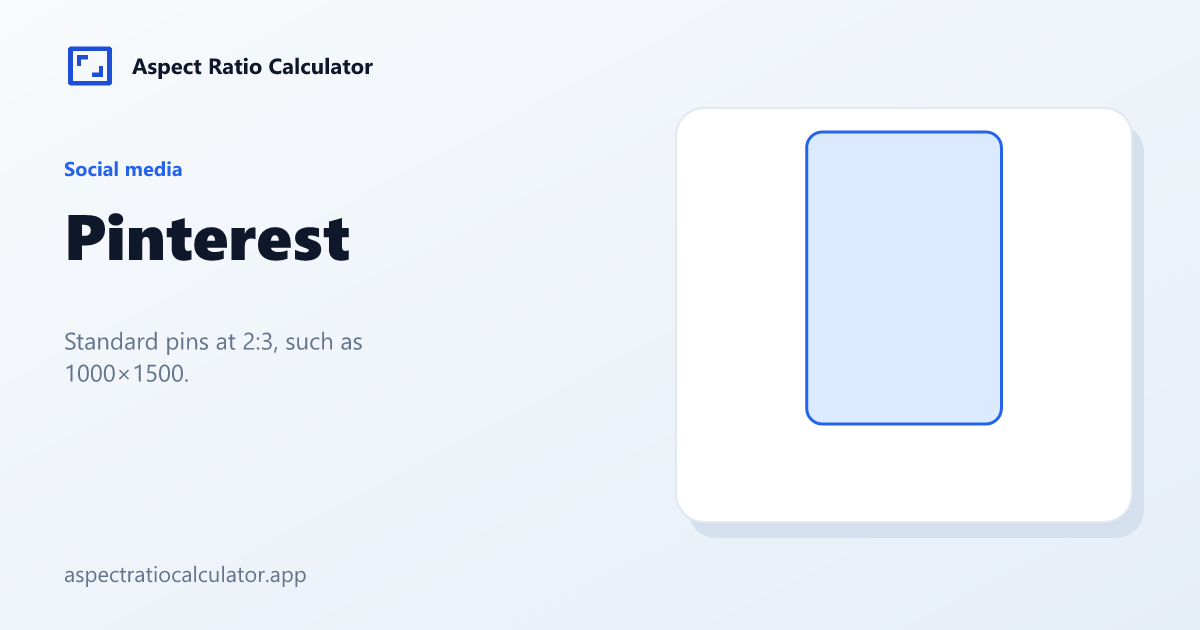
Standard pin: 1000×1500 (2:3). Pinterest creative guidance commonly specifies 2:3 pins (e.g. 1000×1500).
Convert from a 16:9 master
Most cameras and desktop editors still start at 16:9. To reach 9:16, crop 607×1080 or pad 1920×3414 from a 1920×1080 source.
Open any table row in the calculator to set the width or the height in pixels. That is faster than retyping a cheat sheet.
What this page will not claim
Safe-zone UI chrome, bitrate caps and file-type limits change often. We list ratio and pixel size only when the cited help page states them.
Ads placements can differ from organic placements. The Meta and TikTok rows used here are the public ads/help specs, labelled as such.
Notes that apply only to Pinterest Image Sizes
Pinterest creative best practices describe 2:3 standard pins (for example 1000×1500). Video and idea surfaces can differ; those rows stay omitted until a help URL states pixels we can quote.
2:3 is taller than 4:5 and shorter than 9:16. A 16:9 still needs a deep side crop or large pads. Photographers who already shoot 3:2 landscape can rotate to 2:3 with no crop at all.
Design Pinterest image sizes as a tall still, typically 2:3 such as 1000×1500. That shape holds a picture and a headline in one glance. A 16:9 photo needs a deep side crop or large pads before it behaves like a pin. If you already shoot 2:3 or can rotate a 3:2 frame, start there and skip the crop.
Frequently asked questions
Where do these sizes come from?
Only official help or ads-spec URLs listed in Sources.
What is last verified?
The date we last checked that URL. It is not a promise the vendor will not change the spec tomorrow.
How do I convert my existing file?
Use crop or pad from the 16:9 example, or open the converter.
Why is a size missing?
We omitted it rather than invent a pixel pair.